Fixed Panels
A fixed panel is the purest version of a shower enclosure: one sheet of tempered glass standing between your shower spray and the rest of the bathroom. No hinges, no handles, no moving parts. Some people call it a splash guard, some call it a shower screen. Both are right.
What a Fixed Panel Does
It blocks spray. That's the entire job. Depending on how it's positioned, a fixed panel can define a full walk-in shower (where you walk around the edge of the panel to enter), or it can sit next to a tub to keep water off your floor, or it can cap the front edge of a bench in a steam room. The panel itself has no moving parts, which is exactly why people buy it.
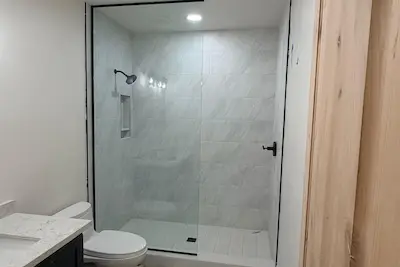
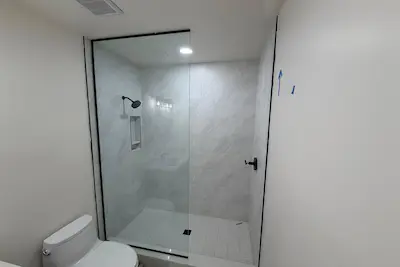
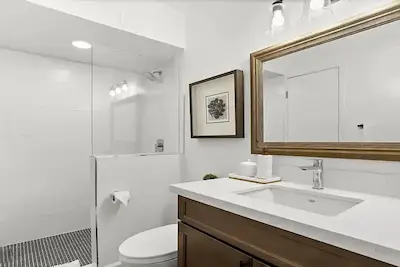
Our single-panel orders come in two forms: a wall-mounted screen that runs from the floor up, and a panel that mounts to a knee wall or half partition. Either way, the glass is cut to your opening and anchored with clamps or a U-channel along the base and one vertical edge.
Why Go Doorless
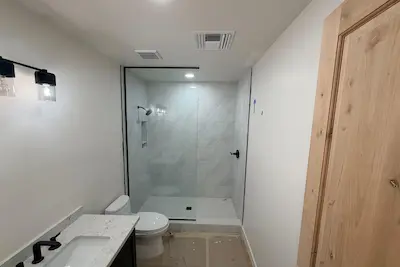
A walk-in shower without a door reads as more open, feels more spacious, and requires zero maintenance on moving parts. There's nothing to stop closing correctly, nothing to pinch a towel on, and nothing to replace after a decade of humidity. For people building a primary bathroom from scratch, doorless is often the aesthetic target, and a fixed panel is the cheapest way to get there.
The tradeoff is spray control. Your shower has to be deep enough that water doesn't reach the opening. Forty-two inches of depth is a reasonable minimum; sixty is comfortable. Less than that and you're going to mop the floor every time you shower.
Splash Guard Use Cases
Fixed panels also work as companion pieces to other layouts. A small panel next to a freestanding tub catches spray from a wall-mounted shower head. A panel above a bench wall stops water from launching over the top. A partial panel on a knee wall bridges the gap between tile and glass in a steam enclosure.
If you're not sure whether you need a full walk-in panel or a smaller splash guard, measure the distance from your shower head to the nearest dry surface. If that number is under 48 inches, you want a full-height panel. Over 60, a shorter splash guard usually does the job.
Glass Weight Matters More Here
Because a fixed panel has no header or secondary panel bracing it, the glass itself has to do all the structural work. That's the one place where we push the 1/2-inch thickness upgrade pretty hard. Three-eighths glass is fine for most panels under 36 inches wide, but beyond that the thicker panel resists flex and feels more anchored when you brush against it.
Height also matters. Anything taller than 72 inches should be 1/2-inch, no exceptions. A tall, wide fixed panel in 3/8 glass will work — but it will always feel less substantial than the same panel in 1/2.
Hardware and Finish
Fixed panels use the same clamp or U-channel hardware menu as our doors. U-channel is the lower-cost option and runs along the base of the glass, hiding the raw edge where it meets the floor tile. Clamps mount the glass at two or three points instead of a continuous channel and show more glass. We prefer clamps on panels under 42 inches wide and U-channel on anything wider, mostly because the continuous support holds better over time.
Finishes are Black, Brushed Nickel, Chrome, Satin Brass, and Brushed Bronze. Pick the one that matches your fixtures and move on — this isn't a decision that rewards agonizing.
This Shipping Policy explains production timelines, shipping methods, customer responsibilities, freight inspections, and damage reporting requirements.
Overview
Custom Shower Glass Doors ships custom-manufactured shower glass products throughout the United States. Because our products are custom-built, oversized, and fragile, shipping procedures differ from those used for standard parcel shipments.
This Shipping Policy explains production timelines, shipping methods, customer responsibilities, freight inspections, and damage reporting requirements.
Production Time
Most products are custom manufactured after your order is placed.
Estimated production times vary depending on:
- Product type
- Glass thickness
- Hardware finish
- Manufacturing capacity
- Material availability
- Holidays
Estimated production times are not guaranteed.
Production may begin immediately after your order is approved.
Shipping Methods
Orders may be shipped using:
- LTL (Less-Than-Truckload) Freight
- Dedicated freight carriers
- Regional freight providers
- White-glove delivery (where available)
- Local pickup (when offered)
The shipping method is determined by product size, weight, destination, and carrier availability.
Shipping Charges
Shipping charges are calculated during checkout based on factors including:
- Destination
- Product size and weight
- Freight class
- Residential or commercial delivery
- Liftgate service (if required)
- Limited-access delivery locations
Additional fees imposed by the carrier after shipment may be the responsibility of the customer if caused by inaccurate delivery information or special delivery requirements.
Estimated Delivery Dates
Estimated delivery dates are provided for planning purposes only.
We are not responsible for delays caused by:
- Weather
- Carrier issues
- Labor disruptions
- Supply chain shortages
- Acts of God
- Mechanical failures
- Government actions
- Other circumstances beyond our reasonable control
Shipping delays do not entitle customers to order cancellation, refunds, chargebacks, or consequential damages.
Delivery Requirements
Someone 18 years of age or older should be available to accept delivery.
- Customers are responsible for:
- Providing accurate shipping information
- Ensuring delivery access
- Moving products indoors after delivery
- Inspecting shipments before signing
Missed deliveries or re-delivery charges may be billed to the customer.
Freight Inspection Requirements
Before signing the delivery receipt:
Customers must:
- Inspect all crates and packaging
- Look for broken boards, punctures, crushed corners, water damage, or broken glass
- Photograph the shipment before opening if damage is suspected
- Note ALL visible damage on the carrier's delivery receipt
Signing a delivery receipt without noting visible damage may limit or eliminate freight claim rights.
Concealed Damage
If concealed damage is discovered after opening:
Customers must:
- Notify us within 48 hours of delivery
- Retain all packaging materials
- Photograph the damage
- Photograph the packaging
- Provide the order number
- Cooperate with carrier inspections
Failure to preserve packaging or timely report damage may result in denial of the freight claim.
Risk of Loss
Risk of loss transfers to the customer upon delivery and acceptance of the shipment, subject to applicable law and any written agreement to the contrary.
Refused Shipments
Customers who refuse delivery of correctly manufactured and shipped products may remain responsible for:
- Original purchase price
- Original shipping charges
- Return freight
- Storage charges
- Restocking fees (where applicable)
- Collection costs
Shipping Address Changes
Requests to change the shipping address after production begins may:
- Delay shipment
- Increase shipping charges
- Require order modification
- Be unavailable depending on production status
Lost Shipments
If a shipment appears lost:
Please contact us immediately.
We will work with the carrier to investigate the shipment.
Carrier investigations may take several business days before replacement or reimbursement decisions can be made.
International Shipping
International shipping may be available upon request.
Customers are responsible for:
- Customs duties
- Import taxes
- Brokerage fees
- Local compliance requirements
International warranty service may be limited.
Order Tracking
Tracking information will be provided when available.
Freight carriers may update tracking less frequently than parcel carriers.
Customer Pickup
If local pickup is offered:
Customers must inspect products before leaving our facility.
Once products are accepted at pickup, responsibility for transportation transfers to the customer.
Force Majeure
We are not responsible for delays or failures caused by events beyond our reasonable control, including natural disasters, severe weather, labor disputes, governmental actions, pandemics, transportation disruptions, or supplier shortages.
Project Gallery



You May Also Like
Customer Reviews
Be the first to review this product!


